
What a Pentest Is Supposed to Do For You

A good pentest should change how you think about your own product. It should tell your engineers exactly what to fix and how. It should give your board a risk story they can act on. And it should hold up under a real audit without being built only for one.
That's the standard we build everyengagement to. Here's how.
Senior Talent, Every Engagement
Every Wolfpack engagement is led and executed by senior practitioners with real-world experience building, securing, and attacking complex systems - start to finish. No handoffs to junior resources. No offshore review cycles. The person on your kickoff call is the person doing the testing.
That matters because senior judgment is what finds the things automated scanners architecturally can't see: authentication and session abuse, RBAC escalation, business logic flaws, API and BOLA issues. Our Attack phase is built around exactly that: the deliverable isn't a vulnerability count off a scan, it's proven exploits found by someone who thinks like an attacker.
Where AI Fits In
And AI? To us, it's a tool, not a differentiator. Our team uses it to accelerate OSINT gathering, crawl the dark web for exposed credentials, and map an environment faster than manual recon alone. What it doesn't do, what it can't do, is replace the creativity, the intrinsic knowledge of which threads to pull on, and the judgment to know when to stop before a test goes further than it should.
Findings Built for Engineers, Not Filed by Auditors
Testing only creates value once someone fixes what it finds. Our findings are delivered as code-level, developer-actionable guidance. The Fortify phase of our methodology closes with a live readout alongside your team, so remediation starts as a working session, not a scavenger hunt through an appendix. We align risk tolerance, dig into how to coordinate across teams for remediation and more.
Remediation Validation
Finding a vulnerability is only half the job — confirming the fix closed the gap is the other half. Remediation Validation is a named service in our lineup, and retesting is built into the Fortify phase itself. Work with us on Slack, Teams, calls. Getting in the weeds and fixing things is part of our ethos.
Fixed-Cost, Fast-Start Engagements
We move from signed agreement to active testing in as little as 10 business days, and the Application Security Credits program lets you draw down bulk hours across any Wolfpack service at a fixed rate. Two things follow from that: pricing you can predict with no scope-creep surprises mid-engagement, and testing that doesn't have to be one enormous annual event — it can be spread across the year to track your actual release cadence instead of locking you into a single point-in-time snapshot.
Reporting Built for the Whole Room
A vulnerability count means something to an engineer and very little to a board deciding whether to fund a remediation sprint. Our Analyze phase maps technical findings to business impact: exploit validation, a risk heatmap, revenue risk context and every engagement produces Board-Ready Reporting: a concise executive summary paired with the deep technical detail your engineers need. One report, two audiences, nothing lost in translation.
Aligned to Business Risk, Not Just the Audit
Compliance is a real requirement, and we meet it, but it's the floor of what we deliver, not the ceiling. Every engagement opens with an Align phase: an executive and engineering kickoff where we identify your critical assets, build a threat model, and set rules of engagement around your actual business risk. We call the result Compliance Checkbox+ you satisfy the requirement and walk away with testing that would hold up even if the requirement didn't exist.
What That Looks Like Next to a Standard Engagement
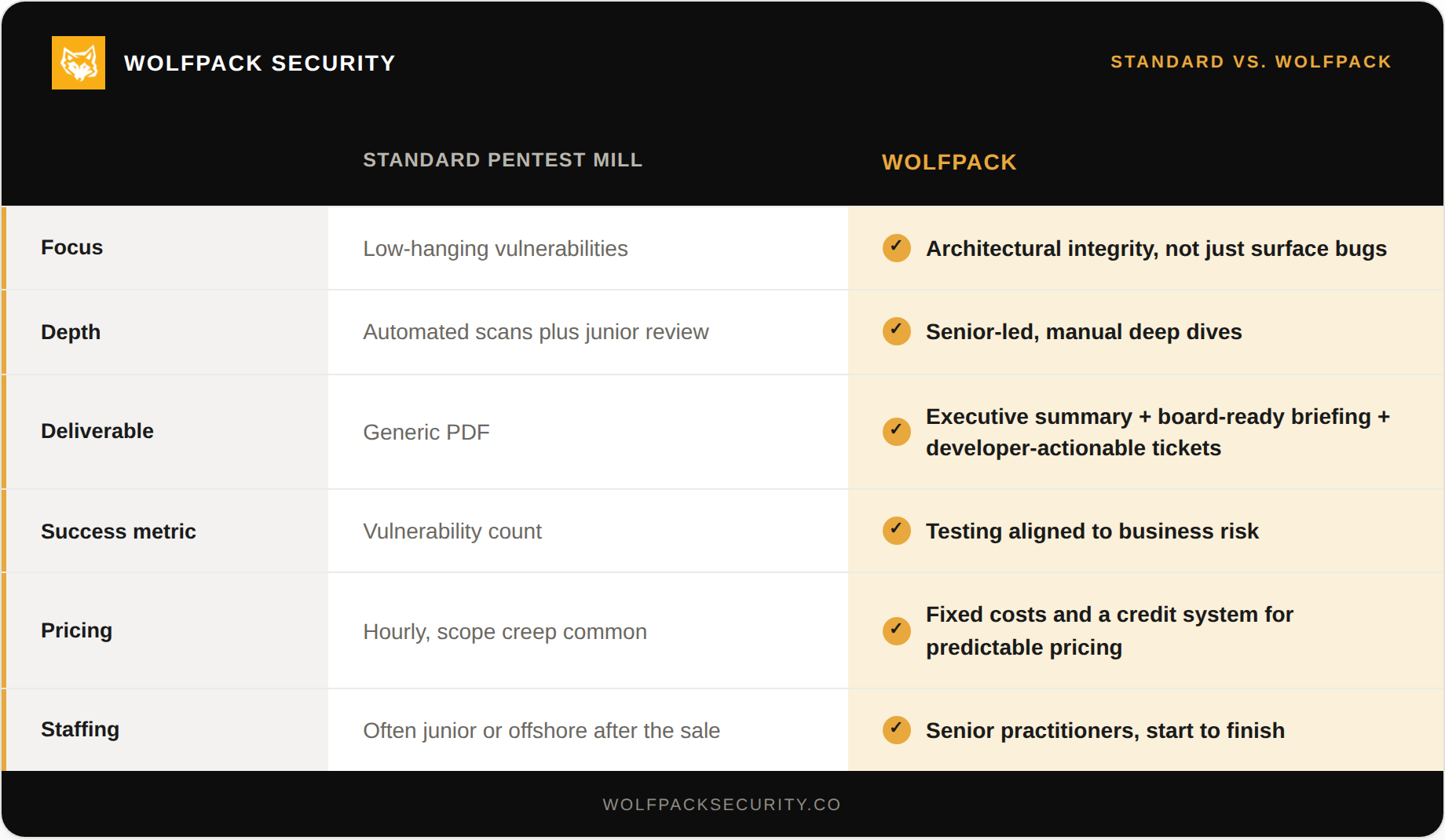
The Combination Is the Point
No single line item here is a silver bullet on its own. It's senior testers who find what scanners can't, findings that plug into how your engineers already work, retesting, pricing that doesn't creep, and reporting that speaks to your board and your backend team in the same document. Working together turns a pentest from an annual ritual into something that moves your risk posture.
That's what “boutique built for the enterprise” means in practice: security that keeps pace with engineering, not security that engineering must work around once a year.
Want to see what that looks like for your product? Reach out at howl@wolfpacksecurity.co.
